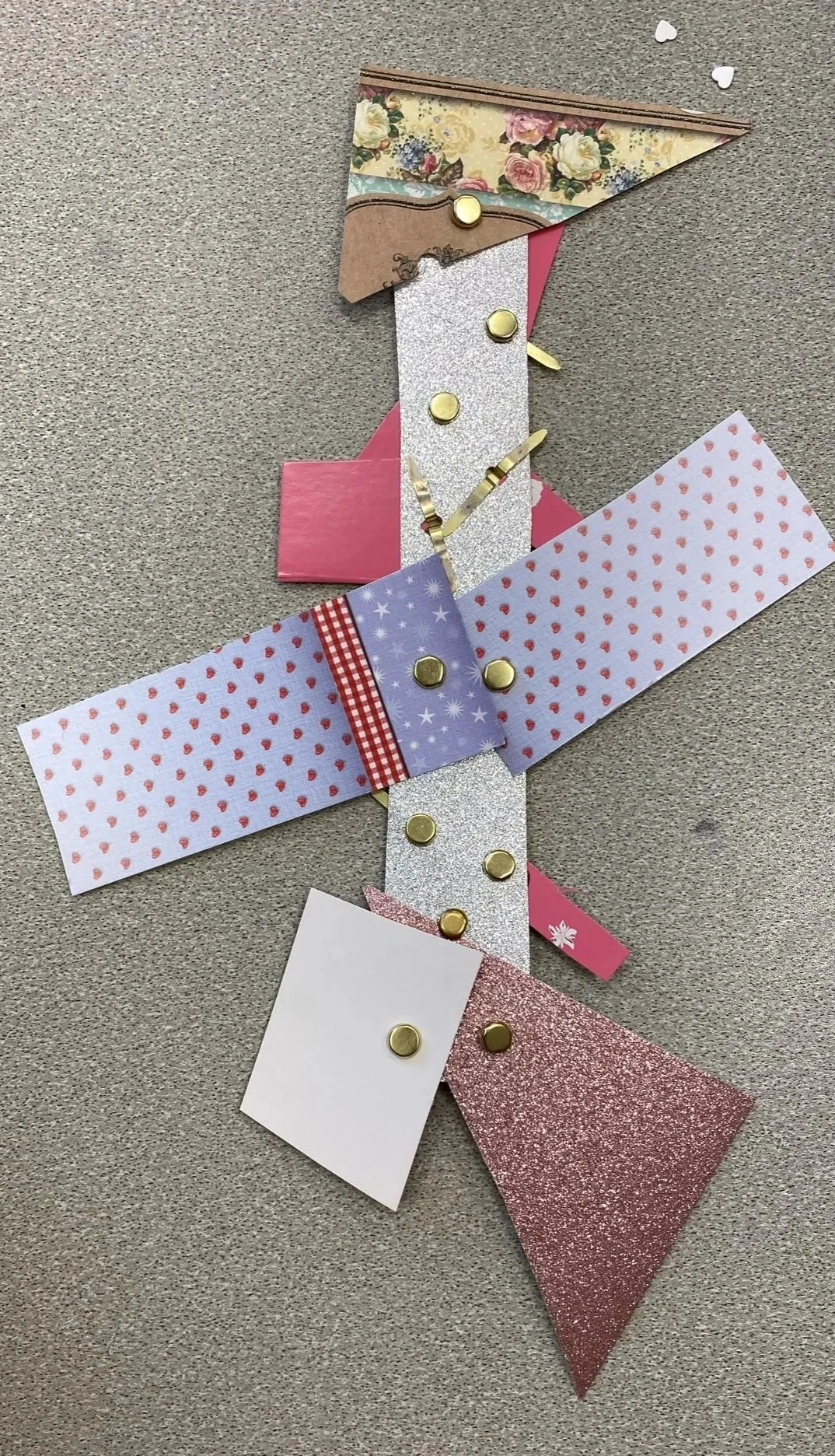
This week, during my Thursday morning visit to the youngest children in the school, I was prompted to think about what children write and why they might choose those things. During the first half of the morning, my basket of writing things is available to choose from. The basket contains pens and pencils, card shapes, small spiral bound notebooks, envelopes, folded books of different kinds, washi tape, sometimes stickers, and each week some slightly different provocation for drawing, writing and making. This week I added more card shapes, a hole punch and a box of split pins. This year, in Reception and Year 1, the folded book is the most popular item.
What did they choose? A Year 1 child wrote and illustrated a book, The World of Cats and Dogs. Some children joined card with punched holes and split pins - a fiddly business. One Reception child chose, as always, a concertina book in which she drew herself and added her name. This week she added a drawing of me on one page and some strips of washi tape for good measure. In an early book she drew herself on each of the four pages, starting small and ending the big person she is now. Every week she affirms her presence, whilst a Year 1 child drew a family story and dictated the text for me to scribe. When the class teacher saw it, she was able to relate it to what she knows of that child’s current home life and the story took on added significance for both of us. A Year 1 child spent a long and careful time constructing a goose from the card and pins; two others looked at each other and asked, shall we play babies now? And they did.
Later, in the Year 1 and 2 writing class we read Peter Reynolds lovely book, The Word Collector and they set about making our own word collections. Some children loved the opportunity to pick from a whole pile of words cut from packaging or printed on card.
Others wanted to write their own words and some chose a combination of the two. Some celebrated sound, some celebrated their love of football or colour or animals or the look of the words on the page. A Year 2 child had much mischievous fun putting words together to make phrases, ‘smelly socks’. A Year 1 child, eyes glowing with the pleasure and achievement of it, began to write an account of their school day, beginning with getting up, tooth cleaning and hair brushing. It was the longest piece of prose I had seen her write independently.
Julia Cameron advises us to start right where we are. ‘Wherever you are is always the right place.’ These children affirm their presence in the world, relish words for their own sake – and combine them playfully and explore aspects of their own lives that are troubling or to be celebrated. They have put down on paper something that they know or that they imagine or would like to be. This week they experimented with card and split pins and words of all kinds and the creator of the goose spent a time of meditation and concentration constructing the flamboyant bird. They have told their own stories and explored their current preoccupations through drawing and writing and playing together.
These possibilities are open to us all. Some of us may not write regularly, but we may all have had occasion to find writing important -in celebration, in anger, in grief; for sorting out and setting down; for ourselves alone or to share with another; for keeping a record, for remembering, or for finding a time in the day simply to meditate upon the gooseness of a goose. Of course there is a value in knowing about style and form and how to write a formal letter, but more than anything I would like to think that children learn the ways in which writing can be theirs.
Here is Julia Cameron again:
If we eliminate the word “writer”, if we just go back to writing as an act of listening and naming what we hear, some of the rules disappear. There is an organic shape, a form-coming-into-form that is inherent in the thing we are observing, listening to, and trying to put on the page. It has rules of its own that it will reveal to us if we listen with attention.
Shape does not need to be imposed. Shape is part of what we are listening to. When we just let ourselves write, we get it ‘right’.
Give yourself space and time to write. Let us make listening spaces available to those we teach. Let us allow ourselves to write.