Words
Books with a focus on words, orthography, punctuation, alphabets
Words: Jeni Smith.
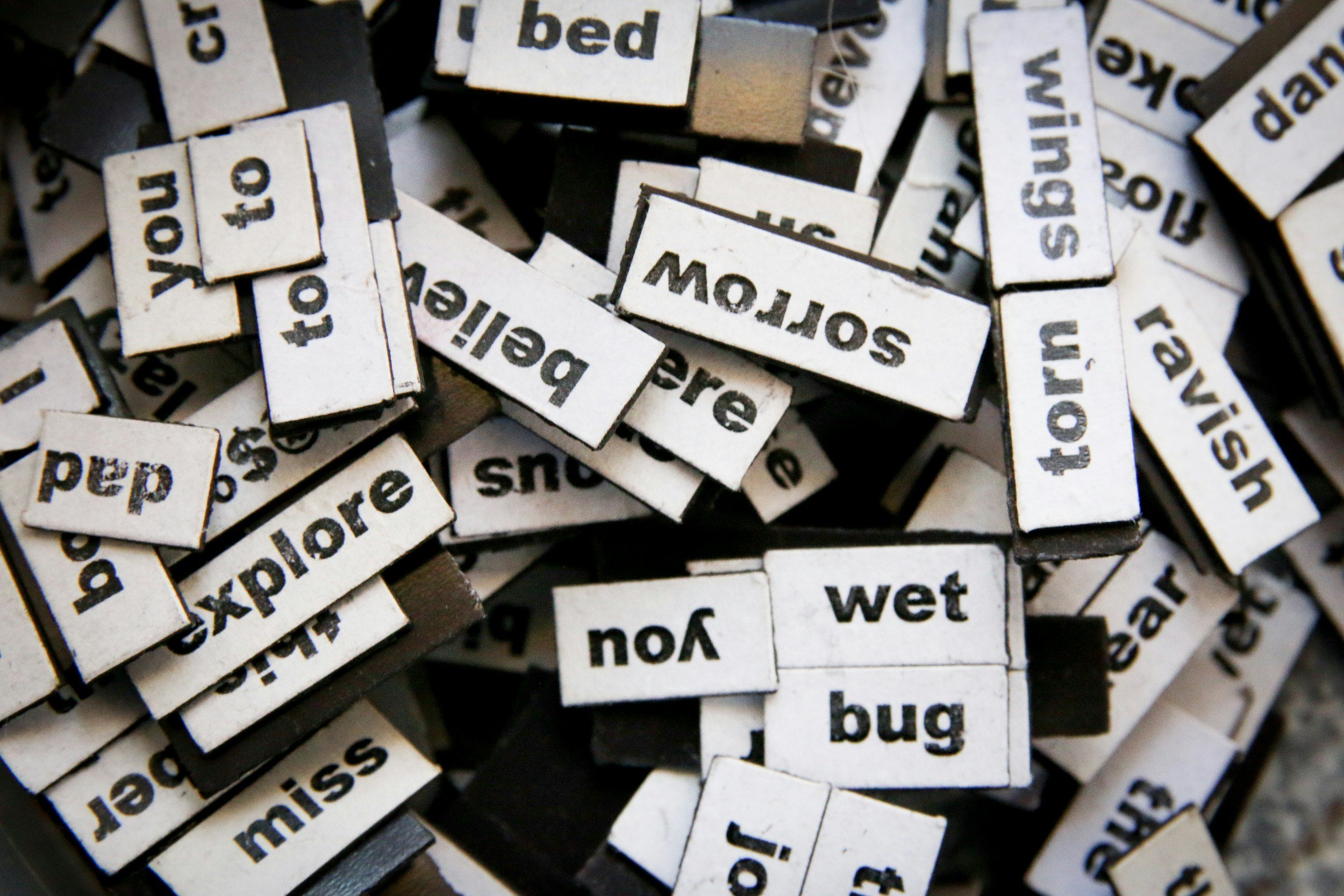
Alphabet books Alphabet books are full of fascination and are not to be reserved for very young children alone. The alphabet provides a useful (though sometimes tricky, sometimes restrictive) way of structuring a list of words. The combination of words and illustrations in most alphabet books provide readers of all ages with plenty to see and to think about. They often include surprising information, verbal and visual jokes or a particular lens through which to see the world. Many of the best alphabet books in my collection were found in charity shops. Some are obscure or out of print. I recommend the shelves of charity shops as a good source for your own collection. I have included books that are collections of words not restrained by the alphabet. Many children love the busyness of Richard Scarry’s books and they always spend time poring over Brian Wildsmith’s Amazing World of Words which is a beautifully illustrated combination of vocabulary list and match the pictures.
Dictionaries, glossaries and thesauruses
There are any number of these to choose from. You may well have a class set of Junior Dictionaries or something similar, but don’t limit your classroom or workroom to just one edition. Even children in Key Stage 1 love the excitement of a large dictionary -The Shorter Oxford Dictionary in two volumes, Chambers Dictionary, and many others in between. There is pleasure to be found in specialist dictionaries and glossaries: etymological dictionaries, those that specialise in dialect words or particular aspects of the English language. I have dictionaries of slogans, eponyms, phrase and fable. I have my father’s French/English & English French dictionary of technical terms and phrases related to science and engineering, and a Lag’s Lexicon published in 1950 which I found in a bookshop in Cromer. I haven’t yet found a use for that and to be honest, it is not for the faint-hearted, though or perhaps, because, at is strongly redolent of its time. All these collections of words and their meanings and derivation are rich mines for any writer.
Adams, D., Lloyd, J. (1983) The meaning of Liff. London: Pan Books and faber & faber.
This is a dictionary dreamed up by Douglas Adams and John Lloyd who have provided much needed meanings for place names of the British Isles and beyond. Here’s what they say in their introduction:
‘In Life*, there are many hundreds of common experiences, feelings, situations and
even objects which we all know and recognize, but for which no words exist.
On the other hand, the world is littered with thousands of spare words which spend their time doing nothing but loaf about on signposts pointing at places.
Our job, as we see it, is to get these words down off the signposts and into the mouths of babes and sucklings and so on, where they can start earning their keep in everyday conversation and make a more positive contribution to society.
*And, indeed, in Liff.’
‘Hickling (participial verb) The practice of infuriating theatre goers by not only arriving late to a centre-row seat, but also loudly apologising to and patting each member of the audience in turn.
Lindisfarne (adj) Descriptive of the pleasant smell of an empty biscuit tin.
Pimlico (n) Small odd-shaped piece of plastic or curious metal component found in the bottom of kitchen rummage-drawer when spring-cleaning or looking for Sellotape.’
You can see that this little volume must find a place on your library shelves. It is also fun to create one’s own additions – it is likely that the very important place names in your life are not included. And in 2025, Macmillan published a new edition to celebrate the 42 years since its first publication: The Meaning of Liff: The Original Dictionary Of Things There Should Be Words For.
Anon A Shiver of Sharks This is one of a number of picture books that focus on collective nouns.
Arndt. M.(2022) Snails and Monkey Tails. A Visual Guide to Punctuation and Symbols. London: Harper Collins. This small square book explains the origins and uses of punctuation marks. It is a visual pleasure planned and executed by a graphic designer and filled with interesting stories and useful reminders.
Boakye, J. (2019) Black, Listed: Black British Culture Explored. London: Dialogue Books. In this book, Jeffrey Boakye explores black identity in the 21st century through a list of words and phrases used to describe, define, insult, appreciate, appraise black men and women in a wide variety of contexts. It is part autobiographical, part historical and much, much more, unpacking the words and the way they define and work within the cultures of Britain. Highly recommended
British Museum. (2017) Opposites Early Learning at the Museum. London: Nosy Crow. As its subtitle suggests, this is a book designed for young children, but its collection of opposites illustrated by images and objects from the British Museum is hugely satisfying for the adult eye, also. The choice of images makes this for good discussion and encourages further discovery and exploration.
Crystal, D. (1998) Language Play London: Penguin. This book explores the many ways in which we play with words, with language and so is packed with ideas for writing. Here you will find games and challenges and explorations of word-play which show how fundamental this use of language can be for the development of young speakers and listeners, readers and writers. Despite our understanding that our ability to play with language advances our general metalinguistic skills and ultimately our command of language as a whole, David Crystal is disappointed to report that ludic language is not a feature of teaching literacy nor of the books which young children are expected to read. Let’s change that!
Edwards, N, Uribe, L. (2018) What a Wonderful Word. London: Little Tiger Group. A small, lovingly illustrated collection of words from around the world which we do not have equivalents of in English. They are words that expand our frame of reference and give us small insights into the culture from which the word comes. The Free Word Centre that used to be in Clerkenwell used to write such words on a chalk board outside the café there and published some on their website. It is fun to write using one or more of these words to explore their meaning or to take a different slant on one’s own life.
Escoffier, M. Di Giacomo, K. (2015) Take AWAY the A An Alphabeast of a book. London: Anderson Press Limited.
This imaginative picture book plays with words in the best of ways. Essentially, it plays on the idea of how words change when you take away one letter. ‘Without the A, the BEAST is BEST; without the S, SNOW falls NOW.’ This duo have created a number of books that play in similar ways.
Forsyth, M. (2011) The Etymologicon A Circular Stroll Through the Hidden Connections of the English Language. London: Icon Books Limited. Forsyth, M. (2012) The Horologicon A Day’s Jaunt Through the Lost Words of the English Language. London: Icon Books Limited. If you like stories about language, these are the books for you. Mark Forsyth tells stories and makes connections that are deeply hidden in dictionaries and other less tangible places.
Jeffers, O. (2014) Once Upon an Alphabet. London: Harper Collins ‘If words make up Stories, and LETTERS make up WORDS, then stories are made of letters. In this MENAGERie We have stories, made of WORDS, MADE FOR all the LETTERS.’ This is a collection (or a menagerie, if you will) of very short stories, with illustrations, one for each letter of the alphabet.
O. Jeffers., Winston, S. (2024) The Dictionary Story. London: Walker Books. ‘ … there was one book who was NEVER quite sure of herself. The dictionary had ALL the words that had ever been read, which meant she could say All the things that could EVER BE SAID. Yet, when you read her pages from First to LAST, she didn’t tell a Story like all the other books which is why, one day, this Dictionary decided she would … Bring her words to LIFE!’ So begins this clever and engaging picture book in which the dictionary tells a story using words from her pages beginning with a Hungry Alligator, something Delicious on the D pages, a chase, a ghost, a small cloud, and a series of disasters that lead to the Alligator frightening the Zebra amongst the last pages and ensuing Chaos. Its pages are pasted with columns from a dictionary and illustrated by Oliver Jeffers. We had great fun as an adult group (including the cutting up of a tatty dictionary) writing our own stories as did a Year 2 class soon after our workshop.
MacFarlane, R. (2015) Landmarks. London: Penguin Books. This is a lovely book of words, the landscapes of Britain and the stories of both. Its epigraph is from Norman MacCaig: ‘Scholars, I plead with you,/Where are your dictionaries of the wind, the grasses?’ MacFarlane’s work goes a long way to provide at least one such dictionary. Yet it is much more than a list of words. It is divided by kinds of landscape and in each section MacFarlane tells stories of that terrain, the people who live or have lived and worked there, the sources of his word lists. It is a marvellous intertwining of a love of landscape and a love of language.
McWilliam, N. (1998) What’s in a Word? vocabulary development in multilingual classrooms. Stoke on Trent: Trentham Books Limited. Although this book is publicised as a book for teachers in multilingual classrooms, and its origins lie in just such classrooms, this is a great resource for anyone wishing to explore language with students. It is great for vocabulary development for everyone. I have known adults who have been fascinated by many of the activities described in the book. Above all, they invite readers to look again at the language that surrounds them and to consider and enjoy its many quirks and satisfying patterns.
Nuttall, J. (2023) Mother Tongue. The Surprising History of Women’s Words. London: Virago Press. This exploration of the language used by and spoken about women is, truly full of surprises. It includes some useful insights into the lives of women in the past and may have things to teach us about how we use language now. It offers the kind of information about a single word or cluster of words that is a gift to a writer.
Rand, A. & R. (2006) Sparkle and Spin A book about words. San Francisco: Chronicle Books. This was first published 1957 and its bold, graphic illustrations are filled with exuberance. Very simply, it tells about some of the things that words can do (‘are the names of people … say what you can do: jump and run … say how hot the sun has got…) and what they can be (large or small, polite, a warning or something whispered)
‘Some words are gay and bright
and full of light
like tinsel and silver
and sparkle and spin
while lurk and murk
or moan and groan
are just as dark as night.’
It is a good way of introducing different ways of looking at words and maybe prompting a list of words at the beginning of a workshop.
Reid, A. (1958) Ounce, Dice, Trice. In his Introduction to this slim book full of rich pickings, Alastair Reid sums up the project: ‘This book is an odd collection of words and names, to amuse and amaze you.’ He goes on to talk about the sound and shape of words, ‘All the words here are meant to be said aloud, over and over, for your own delight.’ There are words old and no longer in use and new ones which ought to exist and private family words ‘which deserve to be better known’. This sounds very much like the lists of words we create at the beginning of any writing workshop. There are lists of words: names for cats or for elephants, words with similar sounds or with conspicuously similar patterns. There are squishy words, odd words and words to be said on the move. The book is wonderfully illustrated by Ben Shan’s drawings and one that I return to many times each year.
Reynolds, P. H. (2021) the Word Collector. London: Scholastic. This picture tells the story of Jerome who collects words. He collects words that he hears and sees and reads. He sorts his words, falls and jumbles his words, he pegs them side by side on a washing line and he shapes them into poems and songs and finally he shares them in the best way possible. The text and illustrations are clear and unfussy. They are a call to collect and jumble and order words ourselves and a brilliant way of introducing the idea to any primary school child.
Reynolds, P. H. (2025) the Gift of Words. This is a sequel to the Word Collector which I have not yet seen.
Richards, M. (2022) A History of Words for Children. London: Thames & Hudson. Despite the timeline at the end of the book, I am not sure the extent to which this can be described as a history of words. Nevertheless, it is a readable account of words, writing and their many uses which provides plenty of starting points for writing and for exploration of language.
Rosen, M. (2013) Alphabetical How Every Letter Tells a Story. London: John Murray. This is a generous, nerdy, exuberant book that not only provides the reader with lots of information about the origins and history of the alphabet but also takes the opportunity to tell stories about words and writing. Each letter has its own history, a note on punctuation and any quirks and then a literary story determined by the letter itself, A for alphabet, for example, R for Rhyme, J for jokes. David Crystal calls for more ludic language in schools. Michael Rosen is the writer to turn to to help you answer Crystal’s call.
rosenthal, a. k. & lichtenheld, t. (2013) exclamation mark. New York, NY: Scholastic Press.
This is an exuberant story that tells the story of exclamation mark who stood out and didn’t fit in until he discovers his many uses. Here’s an excuse to go overboard with the exclamation marks!
Truss, L. & Timmons, B. (2007) The Girl’s Like Spaghetti. London: Profile Books Limited.
Here’s a demonstration of all the things that an apostrophe can do and all the tricky ways there are when thinking about placing it on the page – and deciding when not to. Each sentence is illustrated and often there’s a verbal or visual joke. ‘See the boys bat. See the boy’s bat. See the boys’ bat.’
Tyler, D. (2015) Uncommon Ground A word-lover’s guide to the British landscape. London: Guardian Books. Tyler’s book is a good companion for McFarlane’s Landmarks. It is a collection of words and photographs that describe aspects of the British landscape, collected on a journey through Scotland, England and Wales.
Videen, Hana. (2022) the Word Hord Daily Life in Old English. London: Profile Books Limited. Good for those who are interested in the early origins of English, the words and how they were used.
Watson, C. (2019) Semicolon How a Misunderstood Punctuation Mark Can Improve Your Writing, Enrich Your Reading and Even Change Your Life. London: 4th Estate. A whole book devoted to a single punctuation mark? Yes. Cecelia Watson is a knowledgeable and entertaining writer who not only explores the history of the semicolon but celebrates its existence. I found this book, by chance, in a week when the demise of the semi-colon was being reported in the news. This book not only brings the semicolon to life but also explores examples of its various uses in a way that made me, at least, want to make greater, better informed use of this much maligned punctuation mark.
Wilson, T.R. (2022) Every Word Tells a Story. An extraordinary A to Z of etymological exploration. London: Quarto Publishing plc. This is a child’s version of books like The Etymologican. It is an entertaining introduction to the origins of words and the stories that sometimes surround them.
Winkelmann. M. (2017) Odd Couples One word, two meanings. Munich London new York: Prestel Publishing plc. There are no words in this book until the very last pages. Each double page spread presents two pictures illustrating one homonym. It is not always easy to work out what the word. That trickiness seems part of the pleasure of this introduction to words with more than one meaning and an idea that could become a lovely class book.