Daily

I have been considering the ways in which daily writing – and drawing - work on mind and body to shape us as writers: the value of morning pages, the discipline of a daily 1000 word target,  the practice of writing freely for a set amount of time, or for a defined number of pages, the poem a day challenge, the commitment to recording one moment from each day. Peter Stillman suggests we think of a journal as ‘a net for catching the shining particles of the day’, dust motes in sunshine, maybe. I have ditched the shining bit, and just kept the particles. I can often surprise myself with what I choose to write. And I have enjoyed drawing alongside the writing.

I just like the idea of noticing something every day and noting it down. I like the way it makes me look more carefully and how that carries into the next day, making me look out for things, changing my perspective.

Writing daily somehow, changes the way we write and think; the repetition, the regular commitment  both consolidates and surprises, it can shove you into having to find a different way round things, and it can allow you to fail and go back and keep on going back until you have found something that works for you. I find that when I commit to morning pages, my writing is strengthened. I feel it comes more fluently,  that I am more willing to experiment, that I am more agile. Freewriting has a similar effect. Writing for its own sake, writing without any audience but oneself in mind, makes way for playfulness, honesty, experimentation. Writing every day allows us to see what it is that we can do when we write. As we write without pressure, we may open up new possibilities for ourselves. We can try out stuff. We can lay down new writing tracks. We can strengthen hand and mind and imagination.

There is much to be said for the steadiness of a daily routine. August is a month when, for teachers, a different daily rhythm may emerge. Even if each day is filled with adventures, duties, catching up, letting go, there can also be time to create a small space for regular activity. Musicians and athletes know the necessary pains and consequent pleasures of regular exercise. A daily practice is fundamental for artists and thinkers of all kinds. It is an undertaking that shapes and strengthens.

It can set us free.


Summer Journal

First of all, apologies for my long silences.  No good reason, to be honest, but I am delighted to find, two days after a cataract operation, that the text on the screen is really quite dark and clear cut and not, as I thought, unnecessarily blurry. Perhaps it was that peering at a misty screen that was holding me back, even though I hotly denied it. So here I am.

Although I have been silent here, on this website, I have continued to write, alone and with teachers. I continue to see how writing for oneself informs the teaching of writing in powerful ways. I continue to find new pleasure in writing myself. Writing continues to help me think. Writing and drawing and saving ephemera helps me remember. I regret not writing more regularly about ordinary days. So I was inspired by the Foxes, a Year 5 and 6 class, as they created their own travel journals or holiday journals and I have created one of my own this summer.

We have made such journals before. Each one reflects the personality and potential activity of the maker. Many children fill them with their adventures; memories of a moment in time captured for the future. We choose our papers and the size and design of the journal. Some people, choose compact square shapes, to be tucked in a rucksack on a Lakeland walk. Others are more expansive, creating A5 and A4 notebooks with maps and pockets and different kinds of paper. Some focus on a particular holiday destination - slim volumes with maps of the place included, and others ambitiously gather enough pages and pockets to encompass the entire summer. Most of us choose to have two or three signatures in the notebook and we prefer thicker paper that will take watercolours, coloured inks or pastels. We plan to draw and write; to stick in photographs and entry tickets. Some of us may never start. Others will end up with a bulging collection of days out and projects at home.

You can find plenty of videos on line that will show you how to make a three or five hole bound book or you can simply choose a readymade notebook. I recommend Gwen Diehn’s The Illustrated Journal which has clear instructions for straightforward book binding and is full of suggestions and examples of ways to fill it. This kind of journal is very different from my own writer’s notebook, which is full of scrawl and quite a lot of nonsense, crossings outs, lists and the occasional cutting or bus ticket. I have always hesitated to take on an illustrated journal because it seems to me more public and, therefore, more self-conscious. However, this summer I have made a journal and have reached day seven.  I am finding it a peaceful, meditative thing to do. It is nice to draw and use colour and to stick in sweet wrappers and a pressed flower from a bunch my daughter sent me. It calls for a different kind of writing and being.

Many summers ago, a teacher writer created a beautiful summer journal from a Collins Pocket Guide to the Seashore. The book itself was a lucky find in a second hand bookshop in the seaside town where she was staying. She transformed the book into a record of her holiday there. It was full of paintings and poems, maps and stories. It even contained a small compartment cut from the pages where shells could nestle. It was a beautiful object and a unique reminder of that time with her family.

May I suggest that you treat yourself to some quiet journal making? It can be whatever you wish it to be. More than anything it can be time for yourself. And, as you know, any kind of writing and making can find itself back into the life of your classroom. The website holds plenty of ideas to start you writing and drawing, so have a look. I decided to offer a small list of prompts for the month of August, just because I was playing with the idea of alphabets, and it is always fun to have a new list.

Gather a little stash of pencils and papers, colour and tape, scissors and glue. Set a little time aside. Have a lovely summer.


No ideas but in things

‘The Red Wheelbarrow’ is the first  poem that Miss Stretchberry introduces to her sceptical class in Sharon Creech’s novel, Love That Dog.

So much depends ….

JACK

       Room 105 – Miss Stretchberry

            September 13

I don’t want to
because  boys
don’t write poetry.

Girls do.

…

September 27

I don’t understand
the poem about
the red wheelbarrow
and the white chickens
and why so much
depends upon
them.

If that is a poem
about the red wheelbarrow
and the white chickens
then any words
an be a poem.
You’ve just got to
make
short
lines.

Sharon Creech (2001) Love That Dog. London: Bloomsbury.

The ending of Creech’s book gets me every time. And now I am thinking about it, the last time I read it was the very week that the first lockdown was announced. I was reading with a group of Year 5 children and they had suggested we read all the poems (they are gathered at the end of the book) before we started on the story itself. It was an inspired idea for that group. We spent a giddily joyous hour reading and re-reading the poems and talking about them. Trying out different ways of saying them and noticing how they worked.

Who knows whether they finished reading the novel? I didn’t see them again, face to face, for more than a year. But we did continue writing and, as is routine with that class, we always begin with a list of words. And every time we do, we are reminded of their pleasures. In particular, we enjoy the naming of things. Specialist vocabulary: bit, bridle, breeching, tail comb, crupper. Proper nouns, familiar places, brand names: The Pightle, Lidl, Eye, Colman’s, Mitsubishi, Finbow’s Yard. Words that come directly from our daily lives:  mug, bicycle, travel card, flat white, Whatsapp, drains.

And just recently I came across this really delicious four minutes forty-seven seconds of video: No ideas but in things.

You can watch it over and over again to hear a fistful of poets talking about Williams’ poems, teaching us about poems: the breath of them, the line breaks, their mindfulness; Alan Ginsberg on the look and placing of them on the page, Kenneth Koch, enjoying ‘this cluttery, clanking sound’. I don’t do it justice. It is just very good to hear them speak.  ‘Why don’t you write about something nice, Dr Williams?’ and the good doctor himself: “I am a radical. I write modern poetry, baby. I’m an awful person.’

No ideas but in things, William Carlos Williams said. He noticed everyday things and put them in poems: the wheelbarrow, broken glass between buildings, chicken wire, barrel-staves. No one, he says, at the end of Pastoral, will believe this/ of vast import to the nation.  But it is. It wakes us up, makes us alert. Makes us pause. It values our everyday experience, the things that take up most of our time. It moves beyond the individual to shared understandings. It loves language. Miss Creech/ Stretchberry knows a thing or two. You could do worse than introduce her selection of poems to a class starting out with poetry.


A teaching journal

When I was a young teacher, I worked in two unusual and challenging schools. We were often working without a map and it was both terrifying and brilliant. Early on, Michael Armstrong, who was a colleague then, encouraged me to keep a journal. Every day, at four o’clock, I sat down with a cup of tea and recorded stories from my day. I wrote down things that bothered me, or puzzled me, or that I considered a success. Very often, I just wrote down things that had happened without really knowing more than that. Only later did patterns appear. I have been writing journals about school life ever since.

It is what I like to write and it is where writing, for me, is a record, a research tool, a means of thinking and a means of discovery. I find writing in this way utterly absorbing and it is this kind of writing that makes me feel most like a writer.

When I look back at the early journals, I am dismayed by their prim schoolmarmy flavour despite the wildness of the context Very often I was simply catching the moments, hoping enlightenment would come later. I was coy about my part in the procedure. My notes were often cryptic, missing out the detail which I have learned bring things alive and help me to make sense of what I am seeing. Slowly, I loosened up. Threads emerged. I felt able to speculate. And I was lucky to have colleagues who wanted to talk, endlessly, about what we were doing; what students were teaching us. The talk remains essential. The writing catches the moment and allows thinking to unfold.

So I encourage you to keep a teaching journal. So very often it is assumed that writing means ‘being creative’; and ‘being creative’ means writing novels and poetry. For a teacher, writing about the life of the classroom is creative, is intellectually satisfying and is emotionally worthwhile. It is a way of making sense of what we and those whom we teach are doing. In making sense we create meanings and consolidate and develop our practice.

If that sounds too worthy, then shake yourself free of that idea. Just capture a story or two each day and see what happens.

This is the thing. Make a cup of tea and sit down. Open your notebook. Write the date and time and let the day come back to you. Write down what immediately comes to you. Sometimes, there will be one overwhelming event. Sometimes, a brief moment will have stayed with you -the way a child smiled, the hush as you read the last chapter of a novel, the surprising solution a child found to a maths problem, the emotions that surged when, yet again, Galahad the Restless could not settle to the task. .

Start by recording the story. Write down what happened. What words were spoken. Maybe what you felt and thought at the time. Then let the pen go. You may find yourself exploring one idea. You may find yourself writing down a list of small incidents. Be patient. Start with the aim of simply getting some details down. Let the events of the classroom and the writing itself lead the way.

One year my journal began in despair. Daily I reported a sense of failure, of making no headway, of students’ unfinished work and abandoned projects. I constantly questioned myself. Six months later, when re- reading the entries, I saw that much more had been happening than I thought. Although I felt at sea, the students were making headway. In every single abandoned attempt lay the seeds of what became major pieces of work during the next twelve months. I learned how some things come slowly and how important trust can be.

Start today. Use a school exercise book. See what happens.

Michael was an inspirational teacher and thinker. A collection of his papers and essays is available in this free e-book, Another Way of Looking.

Exciting Writing

A teacher asked her colleague, Emily, what she did about children who don’t want to, don’t like to, write.

After a pause Emily replied that she could think of no child in her class who didn’t like writing.

It’s true. I know the children in her class, and even children for whom the mechanics remain difficult want to, indeed, like to, write. It led me to think about why that was. Soon after that another teacher told me of how the teacher taking over her class in September had come to her in amazement, asking what she had done to make that class so enthusiastic about writing.

‘They love it,’ she told my friend. ‘And what is this freewriting they talk about?’

My friend had introduced a daily freewriting session. For ten minutes she and the children wrote freely, non-stop, about anything they pleased. There was time for sharing, too. Children (and adults) who wanted to could read aloud what they had written. And they wanted to. And they wanted to hear each other’s writing.

Which made me think of a Year 2 boy who mystified his teacher, and me, by telling her that what he liked about writing was that it was exciting. We didn’t doubt that writing could be exciting, but this boy wrote the most mundane and pedestrian things, usually no more than one sentence in a single session; nothing intrinsically exciting, we thought.

Then his teacher observed him more carefully when he was writing. He wrote with others around a table. They leaned in and out from the page, often pausing to exchange information about what they were doing;  reading their words aloud and sharing their drawings. They were a little community of writers; and being part of that community, surely, was exciting. What were they doing? They were coming up with ideas, thoughts, memories that started in their heads and which they were able to translate into words and images on the page. Not only that, once on the page it was there to share. And they got to hear other people’s words, also. It was exciting!

What is most exciting, is their sense of agency. They were able to choose what to write and how to write it.

Pause for a moment and think about how thoughts shift around in your head, how they begin to shape themselves into something more coherent and then the hand takes over and those thoughts and arrangements of words appear on page or screen. Exciting!

Which brings me back to Emily, and a Reception/ Year 1 class just before Christmas. We were making garlands from card circles to be hung from a string. We suggested that they think about writing names of special people on the cards, and special Christmas wishes. They could write their own names if they wished (everyone would be able to do that) and then the names of others. Emily and I had their families in mind, I think, but these children set to work writing the names of their friends in school. And they moved on to making cards. They sat side by side, writing and decorating cards for each other. They saw no need for envelopes, secrets or surprises. Harry and Will, crouched together on the floor, explained that Harry was making a card for Will and Will was making a card for Harry. Children gathered round the table where there were gold and silver pens. They offered running commentaries to the future recipient of the card on its progress. ‘We will go to the beach,’ wrote Candice. They were in charge. When I returned to the class in the next week, they were eager to continue this compelling activity.

What is exciting? It is the knowledge that we can write what we want in ways that we choose. Teachers who attend my writing workshops know that they can write what and how they wish. It is something of a joke that they never do as they are told [although they often do] but that freedom, that sense of agency is, it seems to me, crucial as we learn how to write and understand what writing can do and be for us. What is exciting about writing for you? What stops the excitement? Is there something you can do about it?

Children in Emily’s class have agency. They have known since they were in reception that they are in charge of and have responsibility for their writing. They have regular opportunities to write freely. They must also follow given briefs. They do so in the knowledge that their teacher welcomes their personal interpretations and that they can solve any problems the task poses for them in ways that suit them and which strengthen their writing practice.

That is exciting.

Pause, and then write

Happy New Year!

The sun is shining as I write this and I am about to go for a walk with a neighbour. Although the paths are muddy and the breeze chilly it will be the loveliest thing. Sometimes walking feels a bit like writing. Yesterday, despite the sunshine, it took me an age to get out on the road. I suddenly found a number of small jobs that had to be done before I could go out. I prevaricated about gloves and hats. I sat by my muddy boots for quite some time, simply staring into space. And then I was out in the lanes, startled by the yellow of a dandelion, happy to see the blush of mauve in the sky, sitting for a while on one of the benches John has made in the woodland, glad to gaze at the circle of hazels. And, today, how much pleasure there is to be had in walking with a friend.

And so it is with many things. We put off the moment, whether it is the plunge into a pool, the first strides of a run, the rolling out of a yoga mat. Afterwards when we have walked or run or made friends with downward dog, we feel good. Writing can make us feel well. It is good for the mind and spirit and the imaginative life. If you are reading this, you probably know that already. You may have been given, or gifted yourself, a new notebook for the new year. Hurrah! But let’s be realistic, and kind to ourselves. At this time of year we are bombarded with exhortations and advice towards the new  person we are going to be in 2022.The stakes are too high! I have a number of notebooks that I began with a flourish on the first day of several Januaries and they remain  unfilled. Once I had missed a day, or two, somehow I couldn’t go back to it. It is even worse if you have a diary where blank, dated pages serve as reminders of your failure to write on Tuesday and Saturday. It’s already past the first few days of the new year, so let’s start with the kind of cheap notebook that Natalie Goldberg recommends. It is spiral bound, may have a cartoon character on the front and is not so fat it can’t, realistically, be filled in a month.

Filling a notebook a month, getting the words on the page is what Natalie Goldberg recommends. It is our daily jog, our morning flow. Some people write morning pages: twenty minutes of non-stop writing with no expectation, even, that you will read back what you have written. Some people make a date to write with a friend. This is low stakes writing. There is no need to worry about the Great British novel just now. Tjis is just about words on the page.

In last Sunday’s Observer Magazine (2.1.2022) Michael Rosen wrote about the importance of play in his life, of playing with words and, as he learned when his son died, how writing things down helps him to confront the sadness:

… penning a poem about sadness or a sense of loss can leave you feeling better as well. It helps, laying things down on paper. I call it “unfolding”.

Everyone can do this, it doesn’t take expertise. Think of it as doodling with words.

There’s a tyranny to education: learning to write frees you, but we’re restricted by being taught that formal sentences are all that’s worthwhile. Instead, scribble down fragments – think up half-lines mixed with song lyrics, lines from films, things people say. Don’t overthink it - it’s like talking with your pen. This process is a liberation for the mind.

I am thinking that you know all this. And you know how, not only the commitment to the formal sentence, but the requirement to write at particular times and in ways that are defined by others often dominates how children write in schools. For many, it is the only way they experience writing. The young people we teach experience sadness, too. They have complicated lives. They worry about things. Are you able to squeeze five or ten minutes of free writing, playful writing, into their school day?  In schools that I know where there are regular opportunities for free writing, young people like writing, often love writing. And they learn, also, the ways in which writing can be their own, that writing can make you feel better.

So I send you the very best of wishes for the year ahead. Write often. Write for your own reasons.  Be playful and tender. Allow the writing to bring you back to yourself. I hope, also,  that you are able to find the space where children may write for their own purposes and that they learn what a good thing that is.

How about a five minute free write every day? Start with this month’s thirty writing prompts to break into the page, along with an idea from David Morley.

Festive Fripperies

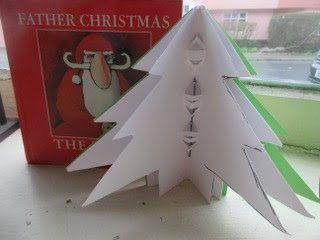
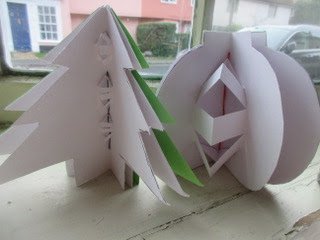
There’s a tradition that at the December meeting of Norwich Writing Teachers  there will be stollen and glitter, paper-folding and gold pens, terrible jokes and, probably, Father Christmas: the Truth. Stollen is tricky at an on-line meeting and some people haven neither glitter nor a gold pen, but we can still get into paper folding. I am amazed and impressed by teachers’ capacity to look at me waving bits of paper around on screen and translate it into their own books and wordy decorations. We do try and create some writing-based fripperies each year and these can often fill a corner in the last week of the Autumn Term.

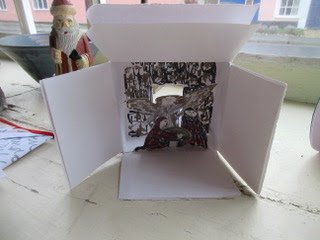
Last week we made garlands from wintery, Christmassy words which I had road tested with four and five years olds -a great success. This week we made simple shaped single pamphlets with rather fancy pop-up inserts and a folded box that can house a tableau and has flaps for accompanying writing. I stuck with the nativity and then got carried away with the idea of a series of boxes charting Father Christmas’s journey across the world on various forms of transport. The idea was inspired by John Burningham’s picture book, Harvey Slumfenburger’s Christmas Present and, of course Raymond Briggs’ Father Christmas.

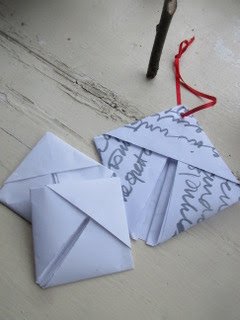
Finally, we folded origami envelopes that can be hung on a tree and contain good wishes of all kinds. We learned how to make the envelope from The Travelling Bookbinder https://www.thetravellingbookbinder.com/2021/12/folded-pocket-decoration/  [worth signing up for her newsletters]. Of course, we missed the festive snacks, the chaos and bustle of the last writing group of the year, but it remains a pleasure to welcome people from across the country to our on-line meeting. (Contact us if you would like to join) Last night I was reminded of the companionship of writing together, the great pleasure to be found in frippery, and how much we learn from each other.

National Poetry Day 2021: Choice

Poetry is …any utterance that sings in a short space: to sing we need all the resources of language -sound, rhythm, beauty and toughness.

Kim Stafford

unsplash-image-9ryDejvQulo.jpg


And we need playfulness, community, a belief in each other and enabling spaces.

 It is a day for celebrating poetry on October 8th. I hope that poetry is in your life most days and that today you have a chance to set aside some special time for it. I think we really need poetry at the moment and that we need to find the nooks and crannies that might hold it during the day. That might mean writing with others, or alone; it might mean pausing to read from a loved anthology or exploring something new; you might choose to write down a poem or a part of a poem and send it at as a gift or you might look to Youtube to find a poet reading their own work.

 Years ago, I was sent off to train to be an Ofsted inspector. We were locked in a basement room whilst we watched videos and listened to the recited script of the trainer. Sometimes we had to write judgements. At the end of one day, I went up to my hotel room and switched on the television. It was National Poetry Day. There on the screen, poets were reading. One after another, they  spoke their poems directly to me. And I found that tears were coursing down my cheeks. What they brought to me was all that had been absent in that basement room: imagination, truth, warmth and surprise, the music of words and human connection and responsibility. Children, especially, discover that they can love poetry and that they are poets. It has a vital part to play in the living and healing that we are engaged in just now.

 In the late 1970s, Kenneth Koch discovered the pleasures of writing poetry with children in New York schools. He came to understand the fundamental value of treating children like poets, realising that it ‘was not a case of humorous but effective diplomacy, as [he] had first thought, it was the right way to treat them because it corresponded to the truth.’ Writing can play a crucial part in our well-being and good health. I have always believed that writing is a form of play equal in seriousness and pleasure to forms of play we see amongst young children. It came as no surprise to learn that, when engaged in creative activities, an adult’s brain is fully engaged in the exactly same way as the brain of a child is engaged when they are busy playing. A poet friend of mine recommended this short TED talk by Lynda Barry and I pass on the recommendation. In it, she speaks about play and about her notion of ‘the image world’ in contributing to our mental health.

 Lynda Berry is an engaging and thought-provoking storyteller -watch it, if only for the story of the boy’s conversation with the piece of bacon he is about to eat. And think about how, in our classrooms and with other teachers we can read and write poetry together for the joy and goodness of it. Kenneth Koch discovered to his surprise that the children he worked with much preferred writing poetry at school than at home. He writes:

“There was also the fact of their all being there in the room, writing together. No time for self-consciousness or self-doubts: there was too much writing and talking and jumping around.”

 Go and read some poems. Listen to some poems.

Get together with others and write and talk and jump around.

Whoop, whoop for poetry day!

National Writing Day 2021: Connections Praise Song

unsplash-image-0aMMMUjiiEQ.jpg

The Women I’ve Worked With

In a final thought, for the time being, about National Writing Day’s theme of connection, and in addition to the power of ‘and’ , connection maps and ‘hair’, here is mention of a poem by Liz Venn which we enjoyed very much last week.

It is called The Women I’ve Worked With and is a praise song. We found great pleasure in writing in response to it. I think some people wrote very personally, and I think some of the writing will find its way to the people it celebrates. More connections!

Here is the first verse:

This is a song for the women I’ve worked with,

for the plasters I’ve borrowed, the aspirin,

for the Friday prosecco, the trainers they wear

to commute and the heels they work in.

And here is the last verse which  sends up a prayer for the usually unsung people who help us through our days:

May every Friday be Cake Friday.

May grey never touch them.

May their passwords be strong.

Your song might be for fellow football players or neighbours. One of the group wrote about parents -the ones discovering how to be parents alongside you – and I thought about all the non-teaching staff I have worked with over the years, the caretakers with mop, bucket and sawdust, the secretaries and bursars who have helped me out of all kinds of pickles.

Here’s Alicia’s song (thank you for sharing, Alicia):

To the teachers I taught with...

To my Hilts, my rock and single support through my NQT year.

For Crazy Em, Fleabag and wordy extraordinaire - you inspire me daily.

To the unnamed for showing me how NOT to be a teacher.

For Mrs K, the OG, the one who taught me everything.

To Cole, of unlimited patience, always hovering at the time out chair when it has all gotten too much.

For other Hannah, my saviour when KS1 science goes too deep.

To Bottom, smiling and tea-ing us all through thick and thin.

For the lady shredding my predecessor to shreds at the inaugural conference - I want to be just like you when I grow up.

And here’s a final verse from another teacher:

You can find Liz Venn’s poems in Cast: the Poetry Business book of new contemporary poets. Her website is https://lizvenn.wordpress.com/poetry-prompts-blog/. She posts poems there and some great prompts to start you writing.

If you would like to read more about her, try Kim Moore’s blog https://kimmoorepoet.wordpress.com/2012/10/21/sunday-poem-elizabeth-venn/

 or the Great Fogginzo’s Cobweb:

https://johnfogginpoetry.com/2014/08/

These are both sites worth knowing about if you don’t already.

Happy National Writing Day 2021!


National Writing Day: Connections

unsplash-image-gSuzqTk7KYQ.jpg

During our last few NWP workshops we have been gearing up for National Writing Day on the 23rd June, and exploring the theme of ‘connections’.

When we were thinking about connections, that useful little word, ‘and’, cropped up. Young children used to write stories that were punctuated by ‘and’, a beautiful daisy chain of action joined on a rope of ‘ands’. I think that they don’t often get the chance to try that out any more because the fullstopcapitalletter police are onto them. In our teachers’ group we had enjoyed some of those ‘and’ connections: hook and eye, egg and spoon, fish and chips and I thought that our very youngest writers would enjoy that collection and connection.

It was serendipity, then, that when I was riffling through the children’s books in a charity shop, a board book by Janet and Allan Ahlberg caught my eye: Doll and Teddy. It is one of four little offshoots from The Baby’s Catalogue and contains all the Ahlberg’s genius for the subject matter and cadences that attract young children.

IMG_7540.jpeg

Open the page and It continues: Duck and bottle; Kittens and Cat;

IMG_7541.jpeg

Bricks and ball, and so on through a flurry of “Butterfly and flowers and bird and worm and ants!’ and:

IMG_7542.jpeg

Making a list of things that go together, joined by ‘and’ is fun, we found, and not to be reserved for the youngest writers only. 

The sound and rhythms of these  pairings are tremendously satisfying and we began to see that there could be themes and jokes. I found myself wanting to rhyme, and maybe adding a few rogue phrases in [whatdyoumacallit, how’s yer father, over the hill…]  There are pairings we commonly use: cup and saucer, salt and pepper, biscuits and cheese; the idiomatic: an arm and a leg, down and out, over and out; and some people began to think of characters from fiction and others searched valiantly for pairings that are unexpected: fish and bicycle, clock and whistle [that sounds like a pub name, there’s another idea]. Is there a connection? 

Here’s Vikki’s list for starters:


Harry and Voldemort

Knife and fork

Bells and whistles

Bread and butter

Coat and shoes 

Brother and sister

Kettle and pot

Jeeves and Wooster

Moon and stars

Salt and vinegar

Hope and glory

War and peace

King and queen

Cat and hat

Lion, Witch and Wardrobe

Alicia is going to invite her Reception/ Year 1 / 2 class to add their and phrases to a paper chain. I hope we may have some pictures after the event. And someone suggested to me once, that ‘and’ was a better word than ‘but’, particularly when giving feedback. Think about it. I often do …

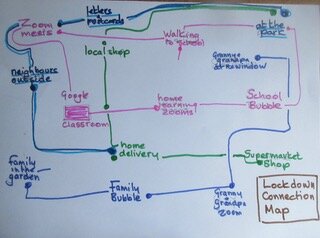
Amongst the other connections that we thought of when we  talked about the theme for this year’s National Writing Day, came the idea of trains and maps, and, in particular, the London Underground map. A group or class tube map could indicate the connections we have made over the last year. You could start by talking about what kinds of connections we have experienced and how they have been made -Zoom might feature as a large station on the line with many connections, but there may be some connections that are unique to one or two people, a connection with a neighbour you had not met before, perhaps, or a particular connection with a local footpath through woods.

The idea is that you make a map, with large and smaller stations that indicate different kinds of connections. Then Lisa suggested that you could have different coloured lines that indicate the kinds of connection being made. You could define these categories and they might give some structure to initial discussions. I have included family connections, friends, school, shopping … But your categories could be different -on-line, by text and hone, face to face close, face to face distanced … You and your group will have your own ideas.

It is a bit tricky drawing the map -it would take time to have it beautifully presented – but I do like it as a visual reminder of the connections we have made – and missed. Then each writer can make their own journey in writing. We only have to fill the box, so you could choose one connection, or write a short piece for each relevant station. We have found that he more opportunities we have had to talk and write about the experiences of the last year, the better we have been able to make sense of them. I think I might give out small squares of paper to write on which could then be attached to your lockdown tube map. 

fullsizeoutput_1a4d.jpeg

National Writing Day 2021

This is just a quick note to remind you that it will be National Writing Day on the 23rd June 2021 and this year’s theme is ‘Connection’. We are invited to write a poem, story or letter, within the box, or in the 280 characters of a Tweet. At our teachers’ writing group yesterday we talked about how we might approach it in our different settings. We were keen to make the day visible within our schools and so we have begun to think about how best to share and display the writing for that day. It may be that you would like to Tweet students’ writing. You can do so using #fillthebox #nationalwritingday @FirstStory. But you may like to exchange poems, stories and letters within the school or to display them so that many people can read them -and connect.

There are loads of resources on the National Writing Day website:

https://firststory.org.uk/writeday/

At our recent meeting we tried out an idea suggested by Kate Clanchy from the Arvon website, using Rachel long’s poem, ‘Omen’ which is a great little anecdote about family hair. We discovered that we all have lots of stories about hair, and that they are often closely tied up with identity, culture and connections of all kinds. One teacher told us of her fascination with barber’s shops -what goes on in there?- another of how she discovered that her much disliked tangly hair linked her to Irish ancestors going back hundreds of years and so now she loves it. There was a hymn of praise and love to a daughter’s distinctive hair and a list of relatives and their hair related to food -inspired by a photograph of a mother with ‘mushroom hair’.

We had a quick look at Neil Gaiman’s picture book Crazy Hair and we were recommended Hannah Lee’s picture book My Hair for younger children. You can find out more about Hannah Lee and how she wrote this book on the Booktrust website https://www.booktrust.org.uk and you can watch a great video of her reading it:

https://www.youtube.com/watch?v=oNet1W_TMqM

I have been able to start writing club meetings in person again this week. We sit outside on the field in the lunchtime sunshine and write together in a companionable way. Writing together is such an important way of connecting. Maybe that is the main thing to think about for National Writing Day. How can we quietly connect through writing together?

This was going to be a quick note – but there is so much to share! We thought a lot about ‘connection’ and there are some good ideas brewing. We plan to share more ideas between now and the 23rd June. Watch this space!

International Metaphoraging

unsplash-image-CTUq_C76p-w.jpg

In the last week of January 2021, I had the pleasure and privilege to run one of three workshops that formed the most recent virtual teacher training conference run by European Association of Creative Writing Programmes.

We met on three consecutive evenings: 23 participants from 17 countries, world-wide. The remarkable (and very persistent) Lorena Briedis had been asking Simon Wrigley and I to contribute ever since she attended the Metaphoraging  workshop that we ran together at the NAWE conference in 2018. Simon wrote up the workshop for the website and you can find that in the archive.  I remember it as a little bit crazy as we crammed two hours of workshop into one. It was, as ever, hands on, full of paper and glue and scissors, cut up card and folded books and boxes of knickknacks and treasures. How would this translate to the loneliness of the long-distance Zoomer?

This question of engagement and energy, presence and connection, was something all three presenters tackled and I wish that I had been free to listen in to the other two workshops: Mariana Docampo from Argentina on ‘creating a workshop from the text analysis method’ and Renée Combal-Weiss  from France, who explored ‘creative tools to enable connections between home and the virtual classroom’ and, as I learned, had everyone writing stories together. In our workshop we collected words -and, as we heard them round the group, it was wonderful to hear many words not in English [fifteen countries represented, world-wide] and to hear how people who are already fluent in two or three languages were learning still more. I, as always, when in the company of others working in a second or third language, was overwhelmed by the generosity and energy of those who worked with me in English. What exactly is metaphoraging? one participant asked me. Well, it’s a word that Simon coined when we created our workshop, and it is a term I have come to love. I’ll write about it more in another post. For the time being, enjoy that combination of metaphor and foraging.

I had sent out a list of things to bring to the workshop; not simply paper and pen, but scissors, a stapler if you have one, a handbook or reference book of some kind and a small box of treasures to replace the treasures that Simon and I usually take to the workshop. People responded with such imagination and willingness. We made little flip books and invented characters and colours and put these together with various items of clothing to create a whole variety of possibilities: Marigold’s sky-blue skirt, Amy Spoon’s breezy white pyjamas, Chewsy Fingers’ sunburst yellow waistcoat. We worked within several linguistic structures and, a favourite activity, we foraged for noun phrases in the books we had brought with us. The phrases became metaphors as we completed the phrase “the moon is …’ The moon was transformed into delicate stitches through the language of a book on embroidery, the stars and planets each became a bird with distinctive plumage. 

Using the rooms where we sat, our collections of treasures, and even other rooms of our homes, we went on a scavenger hunt. If you have used a scavenger hunt, you will know that the search is, essentially, metaphorical and the language reflects that. Of course, and I should have considered this, some of the language sent participants to Google translate. It also drove us to new perspectives. We reflected on the swoop of a warm woolen shawl. We heard the story of the ‘footstep of a hero’ which was a clump of wool collected from the landscape of the `Faroes Islands, where such a collection is regarded as lucky. There was not time to put our treasures to full use, but it was wonderful to see what was in the collections and to see their potential for story making and as metaphors for writing. One person brought a great selection of cooking utensils that I longed to hold.  Amongst another collection there was ‘something hidden’, a Roman amphora, beautiful aged glass that is usually hidden away so that it is protected, and another footstep of a hero, shrapnel from the Dardanelles, so different from the soft sheep’s wool  from the Faroes.

On Thursday evening, after the final workshop, we met for drinks and chat. I was thrilled by the warmth and energy of those writer teachers and thrilled to be in touch with so many people, world-wide, who love writing and want to share its pleasures and possibilities with others. Lorena Breidis has worked tirelessly to arrange the conference and hosted everything with such generosity and affirmation. She was ably supported by her cockatiel, Juanita, who flew about the room, landing on Lorena’s head or shoulder as we all talked. Renee Combal-Weiss, who had been listening in to Metaphoraging, shared some lines from her response to Roger McGough’s poem, Me: If she were gin she would sip herself slowly, if champagne, she would allow bubbles to fly her into the air, if she were whisky, she would down herself in one. I raised my glass of single malt to her, as I raise it now, to all those writers and teachers, for their enthusiasm and imagination and attention to language, for the knowledge that we are part of a community that dissolves boundaries, that values both our difference and all that we have in common.

Answering Back

What a wonderful bird the Zoom are
When we there we here almost;
When we mute we speak almost.
We ain’t got no sense hardly;
We ain’t got no near hardly either.
When we write, we write what we ain’t got almost.

The last weekend in January 2021 has seen the most wonderful flurry of writing events. It is so cheering to hear news of so many of you out there meeting remotely, writing together, sharing closely. Thank you so much, to all of you who take time to organise such meetings.

They mean a great deal.

This weekend I joined the London group led by David Marshall. There were seventeen of us on screen, sharing as a whole group and moving in and out of smaller groups to write and talk together. As always, the session was beautifully prepared and generously shared. David brought such a variety of ideas and resources, so there was great pleasure in writing for ourselves, and much to be taken on into our various classrooms, both face to face and remotely.

Many of us were very taken with an idea from a Poetry Society worksheet developed with the Orwell Society. All the ideas, centred round poetry and political language, are of interest. David introduced us to Malika Booker’s poem, That Force-ripe Morning and to a form new to me, invented by Karen McCarthy Woolf, in which the poet takes another text – in the case of Malika Booker, a political speech - and answers back to it.

That Force-ripe Morning takes the words of a speech by Nigel Farage after the referendum vote. She creates couplets/ couplings using words from the speech in the first line, and her own words answering back in the second:

Dare to dream that the dawn is breaking,
like cracked eggs in we sky, this force-ripe morning

on an independent United Kingdom
where crapo croak he song each morning

this, if the predictons are right, this will be a victory
grabbed like flies snatched with fork tongue flickering.

We found the whole business of answering back to poetry and prose, to poems we want to take issue with, to advice we want to question, full of energy and promise.

Here, also, is the opportunity to use our own voices, our own language, in response to those who speak differently, think differently. Here is Karen McCarthy Woolf, quoted by The Poetry Society.

I wanted to integrate the two voices, but also to subvert or extend what the original writer was
saying. The cadences of the original determined to some degree the tone of the new text. [...] The
response line is intended to act as an asymmetric mirror of the original. You might have rhyme, assonance, repetition, or a variation. [...] The ‘coupling’ is a response to both prose poems and found poems – and to my own experience as a Jamaican-English hybrid Londoner. I think the impulse to unify seemingly disparate parts is part of a larger poetic.

The Poetry Society worksheet can be found here.

David also introduced the National Portrait Gallery’s exhibition of community based photographs of the Lockdown 2020. I urge you to have a look at it if you have not already seen it.

The last time that this group met face to face, this time last year, was at the National Portrait Gallery. We long for the time when we will be face to face again, manoeuvring our pots of Earl Grey tea and deliberating between chocolate brownie and lemon drizzle. In the meantime, these groups on Zoom have been lifelines. And we have been inventive and compassionate. Jan told me how she has been writing weekly with a friend, the space both a motivation to write and a time for friendship through writing. It has kept her going, she told me. “It’s a comfortable place, It’s a world of words. It’s your own place where you can go to.”

We need those places. Theresa Gooda and her Sussex writers explored a sense of place. She writes “It turns out of course that place resonates more strongly than ever when we are ‘locked down’.”

Alison Jermak has circulated around her group, a wonderful on-line booklet of ideas for diary writing, remembering Anne Frank at this time.

Marjory Caine and her group wrote about winter weather on Saturday. As always, Marjory brought a treasure trove of resources to the group. I was only sorry not to be able to join them for sharing.

Marjory did, however, mention Gigantic Cinema A Weather Anthology edited by Alice Oswald and Paul Keegan. Since it was the second time I had heard the title recommended in as many days, I pass the recommendation on to you. Here’s a link to the Scottish Poetry Library’s review.

And I could not resist including Marjory’s prompt for a short-write:

‘A thunder-storm came on while we were at the inn, and Coleridge was running bare-headed to enjoy the commotion of the elements’

Write for 10 minutes on an experience, real or imagined or both, of winter weather. Place a character or two in the landscape/cityscape, ‘bare-headed’ and let them loose!

Thank you, Marjory! And thank you and good wishes to all of you who are still meeting and writing together. We are so lucky!
Love Writing

There’s no shortage of advice for writers from writers.

In interviews, blogs and newspaper articles we are able to learn from the published and the prize-winning. Sit down, stand up, write propped up in bed, we hear.

  • Craft sentence by sentence (Andrew Cowan).

  • Get the words down fast and then revise (Stephen King)

  • Write what you know (Geraldine Brooks amongst many).

  • Forget the boring old dictum "write about what you know". Instead, seek out an unknown yet knowable area of experience that's going to enhance your understanding of the world and write about that. (Rose Tremain).

We will take the advice that suits us. But what might we take and apply to our teaching?

I have begun thinking about this more deeply. Most writers are addressing an adult audience, most of whom want to be published. However, each one of us is a writer. Each person we teach should learn how writing works for them. I have been sifting through all this counsel to find the ideas that will inform our practice. We probably don’t need to take up Hilary Mantel’s  suggestion that we find ourselves an accountant. Anne Enright’s recommendation of whiskey alongside all her other advice might be an interesting addition to the Year 10 classroom but …

  • Be kind to yourself, say Roddy Doyle and Kate DiCamillo, as do many other writers in their different ways.

  • Love what you do, says Jeannette Winterson.

  • Have fun, says Anne Enright.

Initially, I discounted this advice as irrelevant to the task of teaching writing. The current National Curriculum is unlikely to have much truck with such sentiments as being kind or loving what you do. As for having fun - please be serious. There are criteria to be met. I thought again.

Seriously.

Seriously, having fun, being kind to ourselves, loving what we do, sit at the centre of the writing workshop. We have become dominated by a curriculum overloaded with content and anxious about skills. On-line answers to remote learning emphasise rules and routines. A friend of mine lamented the impossibility of keeping her son focused on the deathly slow progress of a PowerPoint presentation for writing. Yet when she abandoned the prescribed course and went for a walk, weaving writing into the activity, the roles were reversed, her son calling her to wait, while he completed his task. 

Let us begin with our writers, whether adult or child. Place them at the centre of our teaching. Writing springs from safe spaces, mutual encouragement, universal celebrations.

When we find the ways in which we love writing, our writing grows. Let us be kind to ourselves and to each other. 

Happy new year!


What You Need To Keep Warm

I have been thinking about the place that writing can have in people’s lives.

I have said before that writing is a human activity. In fact, people are at the core of any writing, whether as writer or reader or subject. That seems to be overlooked by most recent directives about teaching writing. The emphasis on technical accuracy and grammatical knowledge, on textual features and such, has overshadowed what it means to write.

In our writing groups we experience directly the ways that writing transforms us, both individually and as a community.

We reflect on our own lives and those of others. We shape and re-shape thoughts and feelings. We travel into our hearts. We travel across the globe.

During our last Norwich Writing Teachers meeting we wrote in response to a poem written by Neil Gaiman for the UN Refugee Agency UK: What you need to keep warm. The Agency invited people across the world to send in drawings and paintings in response to the words and then created this video.

When we wrote, we thought of both physical and abstract things that warm us. Emily Rowe shared the video with her Year 5/ 6 class who are isolated at the moment and learning at a distance. One wrote about how hearing ‘Well done, that’s great,’ makes you feel warm. And here are more:

The warmth of a smile
Hugs and fire
A snuggle with grandad
Hot chocolate
Cups of tea
My hot water bottle
Friendship and family

Sometimes, even the warmth of a smile is hidden behind a face mask. That is why I would add the unexpected gift of words to my list of things that warm us.

There is a saying that firewood warms twice -once when you saw the logs, and again as it burns in the hearth. Perhaps words can warm three times, once as you write, twice as you give them, a third time as they are read.

A Creative Space

“It’s a feeling of happiness that knocks me clean out of adjectives. I think sometimes that the best reason for writing novels is to experience those four and a half hours after you write the final words.” Zadie Smith

One of the great pleasures of being part of a teachers’ writing group is hearing other people’s writing. Another, is experiencing the diversity of any group and all the many ideas and perceptions that arise from it: this reception teacher likes nothing better than to write alongside her class;  that one has been walking and drawing maps and writing with her son; another is, over time, finding a way to write  about a crucial relationship; this one loves a good list. I love the fact that we come to writing for different reasons and that when we share our writing and our approaches to writing, our teaching is the richer for it. This summer, Mikela Bond from one of our groups finished a novel.  Amazing! She has written a blog about the process which we have permission to share with you. I think that much that she has to say will chime with you, even if writing a novel is the last thing on your mind.

What seemed most important to her was the finding of a ‘creative space in which none of the other day to day demands mattered.’ In the first instance, she writes, this was something to do with well-being in the life of a busy teacher and parent. And then the novel took over. I like the way that it came to her as fragments. First a glimpse of a woman washing up, sunlight on soapsuds. Mikela had to find the space, often writing on her knee while one child or another was busy with Beavers or swimming lessons. She joined a workshop run by the Unthank School of Writing where much of the hard work of reading and revising took place, but I will let her tell you the story.

Read Mikela’s blogpost here.

What strikes me is how much of what she says echoes through our writing groups: well-being, notebooks filled with fragments, reading aloud and hearing the work of others; researching through books and place, carving out a space. Now, on Zoom, we gather together and children hover around us. One of our Norwich group joins us from a swimming pool car park, her damp son creeping into the back seat towards the end of the session. What thrills me is that this is good for each one of us, and good for our teaching.


A Gift of Words

At our Norwich Teachers’ Writing group this week we wrote about gifts. And we wrote gifts of words. For me, meeting with this group - and with other writing groups – is a gift.

Each time I sit down with teachers to write, I am overwhelmed with the pleasure of it. How good it has been, over the last year of isolations and zooming and lockdowns and remote learning, to sit by a screen and write alongside others on the screen, writing, by their screens.

Of course it is not the same as being side by side - and this year we’ve missed handing round the stollen - but there has been a calm; and an affirmation of our lives, alone and together.

It so happened that our group met this week on the first day of Hanukkah. The Chief Rabbi spoke on Thought for the Day that morning. (You can find it on the Today programme, BBC Radio 4, December 10th 2020, at 7.50am) He spoke about the seven words for ‘gift’ that exist in Hebrew. Each provides us with a different way of thinking about the nature of gifts and giving. A gift can be a blessing, a good wish; it can be an act of appreciative joy, given in the moment, in the present; another word denotes the gift for special occasions, a thoughtful gift; and the fourth word denotes a gift given to a good cause; the fifth is a similar gift, but unsolicited, another example of giving in the moment. Finally, Rabbi Mirvis spoke of a gift that takes time, effort and talent in the making. It draws people together. It is for a greater good. One such gift, this year, he said, has been the development of vaccines designed to prevent the spread of Covid 19.

We thought about John May’s ‘Six Things for Christmas’:

I wish to be given beautiful things this Christmas,
Beautiful but impossible.

It’s a poem that Jill Pirrie mentions in On Common Ground (1987) London: Hodder & Stoughton. She asks us to think of memories so dear to us that they occupy a special place. These can be given, as gifts to those who might share those memories. This year, when we will be sharing festivities with far fewer people, and when some people we know may well be alone, it may be that the words you send them could be the loveliest gift.

Writing Inside Out

I am sorry that I have not published anything here for so long. I have known I should. In April I experienced a life-changing event and have just not been able to find public words. I have written. Writing has remained my lifeline, but, until the last few days, I have not found the energy to write beyond myself. I think that kind of ebb and flow of writing and what we choose to write -or not - may be familiar to most of us. I hope that you have been able to find time to write for yourself. Perhaps you have used and enjoyed the regular writing prompts posted on the site . Have you had time to read Katie Kibbler’s wonderful account of her encounters and commitment to NWP teacher writing groups? If you haven’t already, read what she has to say.  Feel inspired by her!

More than ever, our groups of teacher writers, and those who are not yet part of a group, need the time and space to write, and we need each other. Writing together brings a kind of affirmation, inspiration and comfort that infuses our lives and our teaching. It would be good to hear news of what you have been writing, how you have been meeting. Most of our established groups are writing together by Zoom. Unexpectedly, the Zoom meeting for writers is remarkably different from the many other on-line meetings that you may have to deal with. Essentially, the on-line meeting for writing teachers has become, what one teacher described as ‘a sacred space’. It works so powerfully for our well-being and is, at the same time, ‘the best kind of CPD’. 

During the spring and summer, when teachers were teaching remotely to blank screens, dipping in and out of school, caring for the children of key workers, trying to home school our own children, we, in Norwich, found that our meetings were a space that was ours. I was able, home alone, to run a meeting every week, rather than monthly. And that has proved to be wonderful. People come and go according to commitments and timetables, but we are always there on a Thursday. Sometimes children join us -and that is a pleasure and a privilege. And I have found that we are learning even more about ourselves as writers and teachers of writing.

My usual approach to running a writing group is to combine adult focused activities alongside approaches and ideas that can be transferred to the classroom. I have always included in our meetings some focus on pedagogy or process. But during lockdown, I began choosing ideas and prompts that were designed with the group and our situation in mind. I felt that we just needed the space to write -and to hear other people’s writing, about our days, about what we have lost, and what we have found, pleasures and sadnesses. And there is always laughter. At some point I worried about the teaching part of this venture. Had we lost that element of our meetings? And that is when someone said that this was the best kind of CPD. The weekly commitment has allowed people to stay in the writing moment, and not feel they have to pick it up again after a month or more. A weekly commitment is not necessary, though people reported how they had more frequently gone back to their writing, revised it, developed it. Most importantly, they said that what they were learning for themselves, through writing themselves, was richer and more deeply embedded in their teaching than in other forms of professional development. It is what I have always known at some level. It is hard to capture. It encourages me to encourage you to write with others!

We learn to write from the inside out…

In Our Hands

With Toni Morrison’s words on the home page of the website, it was good to be reminded of our responsibility ‘to do language’; and to be reminded of so much that Toni Morrison wrote that faced up to self-pity and fear.  Since her death last year, I have had cause to read and re-read her Nobel Prize lecture, delivered in 1993 in which she speaks, again, about our responsibilities towards language. The speech is rich and complex. Each time I read it, I take something slightly different from it. The speech is framed by a parable, a frequently told story that Morrison shapes to her own ends. It tells of an old woman, blind, wise, and in this version, the daughter of slaves. A group of children visit the woman and one of them says, “Old woman, I hold in my hand a bird. Tell me whether it is living or dead.” The old woman does not answer immediately. She cannot see them, or whether or not there is a bird in the child’s hand. Have they come to mock her? What is their intention? Eventually, she answers,  “I don’t know whether the bird you are holding is dead or alive, but what I do know is that it is in your hands. It is in your hands.”

‘It is in your hands’.

It is their responsibility. Toni Morrison goes on to say that she reads the bird as language and the woman as a practiced writer. She thinks of language as a living thing, over which we can have control, and ‘mostly as agency – as an act with consequences.’ Language, she says,  is susceptible to death and in  the hands of those who would control and suppress, it is already dead but not without effect. ‘it actively thwarts the intellect, stalls conscience, suppresses human potential. Unreceptive to interrogation, it cannot form or tolerate new ideas, shape other thoughts, tell another story, fill baffling silences.’

Morrison imagines the woman thinking about language. She recognises that language can never live up to life once and for all. She sees its force in its reach for the ineffable. 

Word-work is sublime, she thinks, because it is generative; it makes meaning that secures our difference, our human difference – the way in which we are like no other life.

We die. That may be the meaning of life. But we do language. That may be the measure of our lives.

And then she gives the story another twist. She proposes that the children did not come to the woman in mockery but in genuine search for wisdom. They speak up:

 “You trivialize us and trivialize the bird that is not in our hands. Is there no context for our lives? No song, no literature, no poem full of vitamins, no history connected to experience that you can pass along to help us start strong? You are an adult. The old one, the wise one. Stop thinking about saving your face. Think of our lives and tell us your particularized world. Make up a story. Narrative is radical, creating us at the very moment it is being created. We will not blame you if your reach exceeds your grasp; if love so ignites your words they go down in flames and nothing is left but their scald. Or if, with the reticence of a surgeon’s hands, your words suture only the places where blood might flow. We know you can never do it properly – once and for all. Passion is never enough; neither is skill. But try. For our sake and yours forget your name in the street; tell us what the world has been to you in the dark places and in the light. Don’t tell us what to believe, what to fear. Show us belief s wide skirt and the stitch that unravels fear’s caul. You, old woman, blessed with blindness, can speak the language that tells us what only language can: how to see without pictures. Language alone protects us from the scariness of things with no names. Language alone is meditation.”

We are not Toni Morrison. We are teachers. We write. Children are asking us about the world and about their future. We do have stories to tell. And we can make it possible for children to tell their stories. Together we can keep language alive;  do the word work.

It is in our hands.

Keep On Writing

I am learning, all over again, about the generosity and power of writing, alone and with others. I have been learning about writing all my life. I know it well and I am grateful. Writing has become an old friend, one who continues to surprise me; one who reminds me, gently, of what we have learned together. Writing was there when I fell in love and stood by me in dark times. Writing has helped me keep a record of my days, required me to focus, shown me how I can be a teacher, shown me what I think and helped me to discover more. Writing keeps me in touch. Writing allows me to create new possibilities. Writing steadies me. And when I write alongside others, I am enriched by their writing, by hearing our words on the air, learning new ways, new perspectives, acknowledging our shared humanity and our unique selves.  

Most of us, just now, have more time than usual to write. The need for writing, always there even at the best of times, is accentuated, suddenly acute. I have been moved to see how many of those I know have turned to writing as one way of engaging with this personal and worldwide crisis. 

A month or so ago I began to post ten-minute writing prompts on my Facebook page. I was encouraged to do so by a friend who is not a teacher and would not, I think, describe herself as a writer. She was finding it useful, she said, to write. I have continued to post these prompts. They are on this website also. And sometimes I wonder what on earth I think I am doing. Who am I kidding? More junk.


But I notice quiet responses. A like. A simple comment. A note of thanks: ‘I am loving this 10 minutes a day of writing. It's 10 minutes’ sanity.’ Another friend sends me a beautiful piece of writing about necklaces. I love it. I think there is a poem within it. She sends me the poem, the first draft and the second. We are connected as we are usually connected when we write together. Perhaps even closer. 

And then something else happens. People are beginning to write beneath the prompts. It began with a prompt to write about a recipe –and a photograph of some of my cookery books on the shelf. Crank’s Recipe Book, amongst the line-up, provoked a memory of vegetable crumble, cheese jacks (baked that very day), homity pie. On Easter Sunday, an invitation to write about eggs brought photographs of lovely Sussex Light Chickens and a small tousled headed boy with his stash of chocolate. On Bank Holiday, memories came of other Easter Mondays. And one, glorious, exuberant, personal account of the writer’s  annual family celebration: painted eggs, the woods, children showered in pink blossom, the wild throwing and batting of eggs ‘to smithereens’, then ‘All children must then have their turn with the bats until our party breaks up- the smallest children and their mothers or fathers return home while the rest of us walk on to catch up with important less frivolous news of each other. Next year it will be very special indeed ...’ The writer said she felt better for having let it all out. And we, the readers, were enriched and amused and strengthened by her words. 

This is why we meet to write together. This is why we learn to teach children about writing. Go well and go safely, dear fellow writing teachers. Keep writing. Ten minutes a day. Write with a friend. Tell yourself. Tell each other.